Wednesday, February 24, 2016

Three months

Three months have gone by since Kim's death. At times, it remains surreal.

But the reality of it now surfaces daily. I no longer cry every day. In a lot of ways, I liked it better when I cried.

I don't want to lose my grasp of Kim, her ways, her voice, her biting wit, her love for her children and grandchildren. This new reality is now the family's journey together. And there is a key missing ingredient.

Me and the six kids are dealing with the change as best we can. For each of us, it's certainly similar in ways, very different in others. We grieve differently, we remember Kim differently. But we do deeply remember.

Every day I slide my hand over Kim's urn, I look at her photo, smile and move on. That's both the surreal nature of it all and the struggle with the reality. I've been surprised by the depth of my grief, for we fought too much over 36 years of marriage. We disagreed often on important matters. We both made too many mistakes.

But we shared so much together. And we had become best friends again.

I also no longer struggle so at night getting to sleep. Kim's last day, last minutes, had been haunting me. I'm over that, thank goodness, and have left it in the hands of lawyers I deeply respect and trust. It's best left with them. But there still seems to be a bit of survivor's guilt living inside me.

There still are rough times. One of the worst was finding Kim's glasses. I had misplaced them for a spell, and daughter Mikell was thinking about filling them with her eye prescription. Taking them out of the case, I recalled Kim with those glasses, kitty-wampus on her head because of having to wear a beanie due to her brain tumor surgery.

Mikell had originally picked them up from a St. Peter eyeglasses place in preparation for Kim's post-surgery recovery; contacts weren't going to work for a time. And Kim was pleased with them.

It was even a tougher day when I received a call from the physician who performed Kim's hysterectomy to address her uterine cancer. She asked if I wanted to hear the final report, and I did.

The surgery had been successful; Kim was cancer free. No chemo, no radiation would have been necessary had Kim lived. Ironically, my wife was a cancer survivor...only briefly. We're still searching for the answers. Answers which likely will never come.

Still, my personal journey is blessed by my children and grandchildren. Mikell has moved back for a spell, which I have so enjoyed. And we're now co-workers at the St. Peter Herald. These unexpected windows of opportunity also close quickly, so I treasure them.

And while I try to maintain a healthy balance, not cause the kids to worry about me, yet also provide strength and guidance, our depth of love certainly grows. How can it not? There is so much ahead of us all. And Kim, while likely being darn mad that she's not going along for the ride, would want us to hold tightly to this love.

I have also been blessed with my work, which I deeply love. Getting back into journalism has been a gift. It's also brought me into an amazing new community, with people who care about me and I them. I can not thank them enough.

My new friends at River Rock Coffee and St. Peter Food Co-op, at Patrick's, at St. Peter Public Schools lift me daily. I'm proud to share a sense of community with such talents as Ann Rosenquist Fee and Nicole Helget. Dr. Paul Peterson, St. Peter superintendent, checks on me from time to time, It means a lot.

My passion for and love of music is healing and spiritual for me. It's initiated my new friendship with the talented Mary Jane Alm, prompted me to take in the sounds more often, to grow in new and different ways. This Saturday, I will see gifted Indianapolis singer-songwriter Carrie Newcomer for the first time in over 15 years, when she sings and spiritual guru Parker Palmer speaks in Belle Plaine.

But despite this renewed sense of purpose and hope, it's still a struggle at times, I remain somewhat lost.

It will be an ongoing roller coaster ride, I've been told. It's simply a ride none of us expected.


Sunday, January 24, 2016

Two months

How you doing? The daily ritual following wife's death

Two months. It's been two months since my wife, Kim, died unexpectedly Nov. 23. Nothing's changed, yet everything's different.

My guess is only someone who's had to journey through such loss, such shock to the norm, can understand this dichotomy.

I sensed it almost immediately. In a heartbeat -- Kim's final heartbeat -- life had changed. In the hospital room where all hell broke loose, it had seemed both surreal and dysfunctional. My wife had made it through three successful surgeries in less than six months. Suddenly, she was gone.

I ushered everyone out, stroked her hair and left cheek, kissed her forehead and managed a tearful, "I am so sorry." It might seem an odd first thought, but we had gone through so much together, and now she was going to miss so much more.

Two new grandchildren. Three straight years of children's marriages, with one more in 2016. A daughter moving back to Minnesota from Seattle with her partner. Six children, four grandchildren. Likely more. She was so looking forward to tomorrow.

And a new furnace. The day after Kim died, the Melius house had a new furnace installed. Kim and I had managed through a couple weeks of no heat, huddled in the living room, staying cozy with a couple space heaters, thanks in part to a mild November.

The whole scene seemed rather symbolic of our journey. Managing to get by, yet always looking ahead.

Now, looking ahead is completely different. But there's a part of you which longs for nothing to change. As family gathered in those early days, I remember vividly son Andy saying how he worries he won't remember the sound of his mother's voice. You don't want such memories to fade.

Nearly every day since Kim's death, the question is asked by someone. How you doing?

Pretty good, I might say. Considering the circumstances. When the death is sudden, a shock, and when you have no chance to say goodbye, how does one truly know? Better than what? Better than yesterday? Certainly better than that final hospital scene.

I am moving forward. But I still cry nearly every day. Each night, often before I can sleep, Kim's final minutes of life flash before me again. Every night.

And we still have no answers. Probably never will. Kim's autopsy revealed no clear sign of what happened. No blood clot, which medical personnel at the time suspected. Her heart was strong. Respiratory failure, which caused cardiac arrest. What caused the respiratory failure remains a question mark.

So, how am I really doing? I'm OK. But there's this strong need to check up on my kids, see how they're doing and handling the emotions. We all grieve differently. I cry, sometimes at unexpected times. Sometimes at special songs, favorite memories. But moving on is also important to me, and it should be to all of us.

I'm not overwhelmed by it all. I'm not extremely bitter, even though every part of me believes Kim should not have died. Such anger could destroy one's soul. And I won't let it happen.

You know, I deeply respect people of faith. But I live with a comfortable balance of faith and reason. It's one of my deeply-rooted core principles. And it was not Kim's time. She was boldly moving ahead, dealing with a myriad of health concerns and happy about the direction. And she was still contributing mightily to society in the best way she knew, by being respectful to the aged and honoring them and their families.

None of us wanted that to change. So we hold on to her deeply, yet move on.  But it's so different. It seems almost like survivor's guilt. Every walk, every step, there's a memory. Even the ugly ones, as Matt and I have laughed about past Christmas shopping ventures with Kim. Painful stuff. But now I walk through River Hills Mall in Mankato and feel lost without her.

This feeling likely won't change for me. For it is all so different.


Wednesday, December 23, 2015

One month
My life partner of over 40 years died Nov. 23. Kimberly Ann (Polzin) Melius had just turned 58 and died unexpectedly following complications from cancer surgery. She loved Christmas with family and will be dearly missed this year and beyond.
Life’s journey can be difficult at times, and this is certainly one of those. But nobody knew better than her of life’s circle and the reality of it all. She was a gifted hospice social worker much of her life. Still, for our six children and four grandchildren, Kim’s death hit hard.
I promised myself I’d put together my thoughts one month later, for the days move by so quickly, and life tries to return to some sense of normalcy. But it will never be the same.
Kim was more than a gifted social worker. She was tough. Death isn’t an easy path nor very often welcomed. Kim was gentle and compassionate to those individuals and families, blunt and pointed at times when needed. Her days providing hospice care were her finest, and she touched lives from St. James to Waseca, Arlington to Mankato and beyond.
On the few occasions families allowed me to tag along, I was so impressed with her passion, her ethics and her advocacy for the dying.
A past co-worker of Kim’s said she could be as hard as a nail or soft as a marshmallow, often at the same time. That pretty much summed up Kim.
The kids understood both sides, too. Family life isn’t always simple or easy. Six children and their differing personalities add to the sometimes dysfunctional nature of a large family. We weren’t perfect in our parenting skills and differed often on the right touch.
Marriage, too, can be difficult, and Kim and I struggled at times. But love evolves; it rarely adheres to the same design through the years. As Kim battled through some health issues over the past few years, she and I again became best friends. That might sound raw, but it’s so important.
The kids noticed, too. Nearly every night, Kim would place her head on my shoulder and thank me for helping her through the battles. She had undergone parathyroid surgery in May, invasive brain surgery for a benign tumor in October, and was staring at a third surgery Nov. 23 to address uterine cancer. This one was supposed to be rather routine, if surgery ever is. We’re still waiting for answers as to what went wrong.
I had become her caretaker in many ways. And I was perfectly fine in that role. It’s what you do for your life partner. I had often joked with Kim, sometimes to her sharp eyes, that 36 years of marriage wrecks one’s search for a soulmate. The joke sounds harsh, but there’s some reality to it. And as we both came to understand it and accept such reality, we relaxed and enjoyed life together.
One’s life partner, the love of it all and the great experiences and journey, prompt change. Love evolves and changes with it. Such was our relationship and marriage. Through all the ups and downs, we grew close. And I am so damn grateful for that.
Our jobs through the years often placed us on separate paths, with different friend networks. But this diverse group of friends, as well as those unique networks of our children, surfaced at Kim’s memorial service in Winthrop, our hometown. This overwhelming support, as well as touching words and thoughts on social media, was so appreciated by my family.
My presence in St. Peter over the past 18 months has also brought me into an entirely new network of friends. It was, and is, becoming my community. Kim and I had been discussing a move to the area, our first-ever discussion of leaving our hometown.
You know, when you’re caught between communities, one can feel a bit disjointed. And a sense of community is so important. So I am pleased and humbled the St. Peter community has become such a key part of my life.
That life has been forever altered. But it remains an amazing journey. And there is a great deal of good ahead. Kim would want us all to know that and move forward. And she would remind you to hug your loved ones, tight and often, and never be shy to tell them so.
And we will. Peace to you, my dear.

Friday, September 11, 2015

Daughter’s Gustavus days remembered
My oldest daughter, Ambryn, graduated from Gustavus Adolphus College in 2003. It was not always an easy transition to start for her, moving from GFW High School in Winthrop to this new environment despite just 35 miles away.

Dorm life brings its challenges. And Ambryn only half-joked about being on a first name basis with those in the business office. Leaving her little sister at home also brought unexpected calls from then 7-year-old Mikell, who missed her big sister/roommate and was left with four brothers in the Melius household.

But Ambryn found her way, thanks in large part of her new friends, some great professors, and active involvement with the Gustavus Diversity Center. She and roommate Bethany Mueller of Little Falls became BFFs long before the acronym surfaced.                                        

And in the fall of 2001, Ambryn and other Gustavus students, along with professor Doug Huff, journeyed to India for a study abroad semester. Those global educational dreams grab many of our youth, and those experiences and memories shape one’s soul, principles and convictions.                  

But the Gustavus students’ India trip was cut short by the Sept. 11 terrorist attacks. Most of us remember that day, where we were, the horror of it all, the utter disbelief.

I was standing in my living room that morning, having heard the news and quickly switching between news reports of a commercial airliner crashing into one of the World Trade Towers. And I vividly recall Bryant Gumbel’s expression when the second plane hit; not until then did the full understanding of the day’s events unfold – this was no accident.

Communications throughout the world were disrupted; trying to get in touch with loved ones scattered around the globe was nearly impossible. We didn’t hear from Ambryn for hours.
But that was a far cry from the sights and sounds of New York. The days and weeks ahead were grueling. A total of 2,977 victims died from the terrorist attacks. Nineteen hijackers downed four planes – the two which hit the towers, one into the Pentagon, one into the fields of Pennsylvania.
Those early days following the attacks brought international sympathy to Americans worldwide. Ambryn and her fellow Gustavians were initially safe and continued their studies. It all changed when U.S. bombers struck Afghanistan on Oct. 7, 2001. Pro-American sentiment – President George Bush’s approval ratings hit 90 percent – died quickly.

Gustavus was faced with a difficult decision – bringing the study abroad students from India back home. Ambryn and her classmates, for the most part, disagreed with the decision. But a few years later, Ambryn and Bethany returned to India, feeling a need to finish their work.

It’s all part of the learning process. Dreams and tragedy, friendships and heartache. It is, indeed, a remarkable journey.

And Ambryn’s journey takes a new turn on Sept. 19, when she’s set to marry her partner, Alexandria Kewitt. I’m thinking her days at Gustavus, the trips to India, growing up with four brothers and a baby sister in a Melius household which tried dang hard to allow for individual growth and discovery, all helped.

These words are how Ambryn framed her feelings, just days before the wedding:

“It struck me this morning, as Alex and I stepped up to the county recorder’s desk and asked for a marriage license, that I never expected I’d do this…you know, this marriage thing. Partly because I used to thing marriage wasn’t for me, and then again also because marriage was not allowed for me.

“But today, alongside the woman with whom I’m wildly in love and certain I want to spend my life beside, we walked on up, took up space, filled in spaces, and were provided a means for recognition and rights. Still so much work to do on so many fronts, but for today, I shall be grateful and oh-so-humbled by all whom have come before us.”

Well said, daughter.

Tuesday, November 11, 2014

Death of a friend, a classmate, a great one

Death changes a person. It should. One should reflect on a loved one's life, what it meant to you. What it meant to others.

When I was editor-publisher of The Winthrop News in the '80s, I would often write about a close friend's death. It would often trigger a rush of emotions, from me, from family of the deceased. I didn't write such columns often, but enough to try and bring some sense to death, to the inevitable end we all face. To try and make some meaning of life.

When I was young, I wanted to save the world. Today, I just want to save myself, save my soul. That's difficult enough. And part of saving one's soul, I believe, is to reflect. Search deep. Find some meaning to the madness. Maybe through it all, you'll manage to save your soul, and maybe one or two others along the way.

But some deaths are so much more difficult. When my dad died at 93, he was still sharp, still thinking, still talking politics and baseball. Puddy had become a close friend. And I wasn't yet ready to let him go, so despite his age and a body that failed him, he had much more to give. When my mom died a few years later, her mind had left. Karen's was no life to live. So we were ready to let go of mom.

Losing the first high school classmate, well that's something much different. From the Winthrop High School Class of 1975, all 54 of us were still around...until Oct. 31, 2014. Josef M. Yonkovich of Outing, MN, had battled cancer too long. It was time.

(Right, left to right: Joe Yonkovich, Mark Trebelhorn, me. These guys showed for my dad's funeral. Mark and I made it to Joe's.)

I always described Joe the same way: "He had the brightest smile and an even better hug." I had known Joe in many ways, like playing ping pong in the basement of the Yonkovich home on Hwy. 15 just north of Lafayette and shooting baskets in the loft of his barn, usually with his Lafayette area neighbor, Jim Youngblom. We were golf teammates. Joe had this beautiful swing, which contrasted harshly with my baseball grip.

But while I found success on the high school basketball court and golf course, Joe never really found himself during those times. He had not yet grown to his 6-5 frame, and he was living in the shadows of two older brothers, long gone from the Yonkovich home. I journeyed on my first cross country venture with Joe, visiting his brother Gene and wife Janice in Phoenix, Ariz. when we were just 16.

Joe and I flew to Phoenix together, met up with Gene and Janice who had been hosting Big John Yonkovich, Joe and Gene's rough-around-the-edges father. The three of us turned around and drove a car back to Minnesota and, at 16, learned a new vocabulary. Big John had those massive hands of a farmer and a temper to match. Joe told me the story of Big John tossing a pitchfork into the side of a disrespectful Holstein. I wouldn't have been a very good farmer.

I don't think Joe liked it all that well either, at least not as much as Big John. And when Joe left the family farm behind and headed into the Twin Cities, my visits with him slowed. But the annual treks by Joe down to Winthrop's annual alumni basketball tournament were treasured.

Joe had the dubious distinction of being one of only a couple basketball players ever cut from the WHS program. Increasing participant numbers among boys in the '70s, the advent of girls basketball, and the lack of facilities at old WHS prompted Coach Lyle Muth to reduce his squad. Coach told me many times since then that it was one of his deepest regrets in coaching. In those soon to be discovered alumni tournaments, Joe proved Coach Muth wrong about the cut, right about the regret.

Joe Yonkovich turned into one very fine basketball player. His shooting touch along the baseline was a treat to watch. He had this odd little kick of both legs when he shot his two-handed jumper, ball just a bit above his head. As a teammate, he was great. As a friend, he was unrivaled.

It can sometimes be sad when time and distance pulls friends away. But with Joe, he had found himself. He seemed to enjoy the Twin Cities, found meaningful work with Medtronic and later Boston Scientific. But mainly, he found Susan Olson. They married on May 23, 1997 in Brainerd. The couple had one daughter, Sydonia, still a junior in high school. And Joe embraced three step-children.

Joe also rediscovered the outdoors and loved it. His obituary made that clear: "He enjoyed fishing, four-wheeling, boating, snowmobiling and was an avid sports fan. He especially loved spending time with his family."

I had only met Susan once before the funeral, that years earlier at one of those alumni basketball tournaments. When I hugged her after the funeral, I didn't want to let go. I tried to tell her just how much Joe meant to me, how special he was to my wife, Kim, how my kids remembered how fondly I spoke of him. But the tears returned. So I hugged a bit more.

I hugged like Joe would hug me. With that brightest of smiles and the deepest sincerity.

But what struck me most was Susan's strength and message. She said despite the pain and suffering Joe battled these past few years, it made their marriage stronger. It gave her a deeper sense of his love and commitment to family. Without the cancer, she said, she would have never felt Joe's true spirit.

That is the message Joe leaves us all. Peace, dear friend.


Tuesday, September 23, 2014

Henderson's allure goes beyond the classic cars;
it's about leadership and a love of Main Street 
by Dana Melius

Henderson, a town of just 886, saw its numbers swell by the thousands at last Tuesday's "Classic Car Roll-In" finale. A record 320 classic cars and another 200 motorcycles lined the streets of this small, eastern Sibley County community.

But it's more than just the amazing, restored old cars that draws them in to Henderson. It's an old-fashioned fun night that one rarely sees in these parts any more. It's a historic Main Street that has taken to preservation like few others. And it's about a vibrant leadership network that doesn't slow down and constantly is thinking both outside the traditions of small town and in a bold, "can-do" attitude.

Granted, Henderson's close proximity to the Twin Cities and the riches of the western and southern suburbs helps immensely; but any small town in close proximity could do the same...and hasn't. And the bluffs of the Minnesota River and its Scenic Byway routes into Henderson don't hurt either.

But this is special in so many other ways. Henderson discovered its niche long before its Chamber of Commerce began encouraging classic car enthusiasts and bikers to come to town. Historic preservation of Henderson's Main Street, along Hwy. 19, and the revitalization of the community's educational roots helped springboard this growing excitement and pride of small-town living. Henderson is what small-town, rural life should be about -- a commitment to education, civic engagement and volunteerism, and a renewed desire for a simpler way.

In Henderson, it's not just a pipe dream or dying vision. It's a reality show worth watching.

Monday, September 15, 2014

Coach Chuck Sundeen...and that 14-7 football win over Gaylord, 40 years ago
by Dana Melius

Coach and football were one and the same around these parts for decades. As we've oozed into the gridiron season, the memories of Charlie should not fade. They will, of course, as nearly always seems the case as loved ones leave us. But this fall marks the 40th anniversary, for god's sake, of old Winthrop High School's 14-7 football victory over those feared and fabled Gaylord Spartans. So, the memories remain.

Coach Sundeen died Thursday, April 10. He had not been well for some time, most recently living at Oak Terrace Assisted Living in Gaylord. He was 74 and had not treated his body well through the years. I last saw Coach a couple months before he died; it was the first time since I met him initially in the fall of 1971 that Charlie didn't recognize me. But he still had that formidable handshake. I'll always remember that about Coach. That firmness was in part because he was a powerful man in his day and that grip never left him.

But the real reason for that firm handshake, I believe, was because Charlie was always glad to see you, always glad to visit and reminisce. Coach had gone through a lot in his days, some good, some bad. Like most of us. Charlie's bad days were really bad; his good days were often football related. He was one of the most sincere, complicated, talented, compassionate and crazy son-of-a-bitch I'd ever encountered. We were very close during my WHS days. And I loved him dearly.

Charlie gave me everything he had as a coach. He never thought it was enough, but for this young, aspiring athlete, Coach came in already a legendary presence and figure...and built on that. I was just a freshman-to-be for old Winthrop High School's Warriors that fall. My high school football coach from the previous season, Wayne Schrupp, had resigned and we awaited the arrival of this highly regarded collegiate assistant coach who had built quite the resume in his early years of high school coaching at Pequot Lakes. Assistants from St. Cloud State didn't come into Winthrop, a school with little football success, with a school-best record through the years of just 5-3-1 during the 1968-69 season.

Charlie vowed to change all that for old WHS, and -- little did I know at the time, he was going to put a bulk of that early burden on the shoulders of this lanky, 6-2, 160-pound freshman. In the fall of '71, I enjoyed football but didn't live and die it like Coach. Basketball and baseball were my loves, as well as sneaking in rounds of golf. Football was a distant fourth back then, if that. Track might have even been more to my suiting at the time.

As an eighth-grader, I had been moved up to serve as back-up quarterback to sophomore Randy Gustafson, a bull of a QB. I didn't like quarterback and blame close friend Brian Brigger for that painful, youthful season on varsity. Brian, one year older, didn't come out for football that fall because he knew he'd be varsity back-up and didn't think he was ready. Neither of us were. In one clean-up game, I fumbled the snap from center eight straight times. Senior Dale Isaacson snapped it so damn hard one cold night that Coach inserted the more passive Tim Oakland the second series. But it didn't matter. It was cold, and I wanted to go home. That's gotta still be a state record.
Brian was back the fall of '71; Coach saw his potential early, moved Gustafson to fullback, and saved my soul. Still, Charlie had plans for me. I started at cornerback as a freshman, with close friend Dale Reed on the other corner. Dale, a senior, drew the opposition's best receivers, so it made my life easier but Dale's somewhat miserable. On offense, I filled in at halfback or end, playing mostly when older players went down with injuries. I ended up holding for extra points. And punting.

We punted a lot that fall. One sailed 72 yards at Gaylord, through the end zone, but it didn't matter. The Spartans crushed us, just like they did every year. Three more years of punting and I never launched one farther. But we also didn't punt as much after that. Charlie made us better. We didn't post winning records Coach's first two years at GFW, but one could see the program's growth. Kids wanted to play for Sundeen.

By the time Brigger was a senior, the Warriors went on to a school-best 7-2. Charlie was still demanding. I broke my ankle in the season's second-to-last game at Gibbon and was carried off the field in lots of pain. Trouble is, we didn't know it was broke, so Charlie still said I'd be punting and holding for extra points in the season finale vs. Springfield. I tried one punt, landing on that broken left ankle and said no more. Fine, but I'd still hold for PATs. Anybody could do that, Coach said. Even with a bum ankle. And classic Charlie, he called a fake kick and made me run wide right to try for two points. I was able to slide in ala today's wussy quarterbacks and said no more. Charlie half grumbled, half smiled but gave me the remainder of the game off.

To Charlie, the 7-2 season wasn't good enough because we lost to Gaylord. Still, to most of Winthrop, who never thought this would be a football town, Coach was a hero. And finally, other teams in the Tomahawk Conference took notice.

But Brigger and the Class of '74 left with lots of talent. My classmates were mostly unknowns and, frankly, there was not a lot of optimism as the season unfolded. It was that classic "rebuilding" season that was expected of us. Not from Charlie.

On the first play from scrimmage in the season opener, a Norwood-Young America running back went about 60 yards off right tackle for a touchdown. As defensive captain at middle safety, I bitched loudly at the guys but found that left-side linebacker Les Werner had suffered a concussion on the kickoff and was clueless that play. The NYA back had gone right through his zone, and Les was babbling nonsense. But my thoughts already went to, "Man, this could be a long season."

Charlie's practices did, indeed, make for a long season. He would sometimes perch atop the baseball light tower platform and run "one more play." Those marathon practice sessions often pissed us off, as well as fellow coaches, parents looking for their kids, administrators and -- of course -- bus drivers waiting to take home student-athletes. For Charlie, we were athletes first, then students. Actually, we were simply football players. His.

But these practices served an important purpose. First, Sundeen conditioned us hard in pre-season. We all dreaded those because, in those days, all summer was dedicated to simpler things, like baseball and golf. We needed those first two weeks to get back into shape. We knew it; Coach knew it. More so, Charlie lived and died football. You could see it and feel it. And it morphed into our souls.

That's how Coach turned things around at old WHS. Football not only became important again, it reigned. Football success under Sundeen meant a school year started off with a bang. And that success transformed over to other sports. Coach was making the Warriors relevant once again.

And nothing could put Winthrop High School back on the sports map more than a football victory over fabled Gaylord. The Spartans had dominated the Tomahawk Conference landscape -- and, particularly, Winthrop -- forever it seemed. Gaylord had defeated Winthrop in football for 31 straight years. Imagine that. Since 1943, long before the current crop of Warriors were born, Gaylord beat us up. I was like most Warrior football players, growing up knowing of Gaylord's dominance.

But on October 11, 1974, that all changed. We had already lost twice during the season -- a 16-11 defeat to a strong, first-year entry, Mountain Lake, which sent their monster lineman on to the NFL; and a 20-12 upset in Fairfax. Some blamed that loss on Charlie's insistence that we practice before the game at Fort Ridgely, then show up just prior to game time. I hated that approach, but the more one complained to Coach about it, the closer he cut it. Thankfully, it was just seven miles to Gaylord...with no Fort.

But through those first six games of the '74-75 season, our rebuilding season had also changed. We became pretty darn good. My fellow seniors improved, and with the addition of tackle Jim Sanders returning from reform school, we were becoming feared. Jim's reputation throughout the conference grew by word-of-mouth, at a time when there was not much media coverage. Word had it that Sanders had actually returned from prison, and his long, bushy hair was a menacing look. It didn't hurt either that in a 34-2 whooping of Morton, Sanders chased a dirty opponent lineman 50 yards downfield before catching him in the end zone and landing some punches. Jim's only regret, he told me after the game, was not removing the Morton player's helmet. I loved playing football with Jim and my senior buddies who hadn't been expected to repeat the previous year's 7-2 mark.

And at 4-2 and staring at favored Gaylord the next week, many doubted we would. However, we dominated the Spartans that warm fall night in Gaylord, but led just 14-7 in the fourth quarter. Gaylord's lone score came when me and teammate Jim Youngblom collided going for an interception, freeing the Spartan receiver for a long score, tying the game for a time. You could sense the fear of Warrior fans. But burly sophomore fullback Bob Bussler and brother Tom, a junior halfback, carried the load on the ground. Sundeen was wise throughout the game, spelling the Busslers with senior backs Youngblom and Mark Trebelhorn, wearing down the Gaylord defense.

As the clock ticked down, Winthrop fans in the hundreds roared. Our rebuilding effort had not only surprised the locals, it ended the curse. I remember 1974 WHS graduate Kevin Lindstrand, who had moved on to play collegiate football at Gustavus, leaping into my arms and knocking me down. We had lost something like 40-0 the previous year, when we were loaded.


The post-game celebration was nuts. Fire trucks met us at the Bernadotte turnoff and led us into Winthrop. Fans gathered at the WHS auditorium and treated us like royalty. And we were for a time. You had to grow up in Winthrop at the time and then wear a football uniform to understand what beating Gaylord meant to this community.

And Coach Sundeen soaked it all in. His legend grew. We went on to win our final two games over Wabasso and Sleepy Eye by a 59-0 margin. I ended my football career with five interceptions against Sleepy Eye, which still stands tied for a state record, as I remind my family from time to time. And I owed my four years of growth and team play to Charlie. Not those practices, but to his insistence on perfection and will. We weren't perfect, but damn we tried.

At his funeral, a former Gaylord assistant coach, Mike Quist, greeted me in the Peace Lutheran Church reception hall. I had not seen him since the days Gaylord and Winthrop had merged football programs. I had helped with pre-season workouts; Mike and Charlie became assistants under another coaching legend, Dave Main. Mike and Dave smiled and immediately brought up that 14-7 Winthrop victory. And Mike remembered the same two plays that I did -- a well-timed end reverse that sprung me (and lead blocker JC Chrest, a great center) for a game-clinching 50-yard gain; and my interception of a wobbly halfback pass.  I was burnt bad on that play, but the Warrior pass rush by Sanders, Brian Gutknecht, Jeff Bussler and Johnny O'Brien rushed the throw and saved me. (O'Brien was the meanest 140-pound defensive guard on the planet, but that's another story.)

Mike loved Coach. Both had similar loves and demons. That seemed to bond the two men, Mike traveled from northern Minnesota to send Charlie off and talk football one more time.

Charlie went on to other football successes, including a state championship with the Gibbon-Fairfax-Winthrop Thunderbirds in 1989. But that Gaylord win, I've always contended, might have been even bigger and more important. In the '74-75 season, there were limited playoffs. You had to win the conference to go on in this complicated computer point system. Newbies Mountain Lake went on as the Tomahawk representative, going 8-1. The rest of us only played eight conference games that year, and Gaylord complained loudly, as the loss to Winthrop left the Spartans a half-game back in second.

At Coach's funeral, I was surprised no one stood up and talked about that Gaylord victory in the fall of '74. For those of us who played in Charlie's early years, we recalled it. But memories fade, new ones emerge, and time flies by. Those of us touched by the crazy ways and style of Coach Sundeen will never forget him.

And that's a good thing.

Cutlines
Top: Charlie's obituary picture at his April 19 funeral service.

Second: The 1970s Coach look.

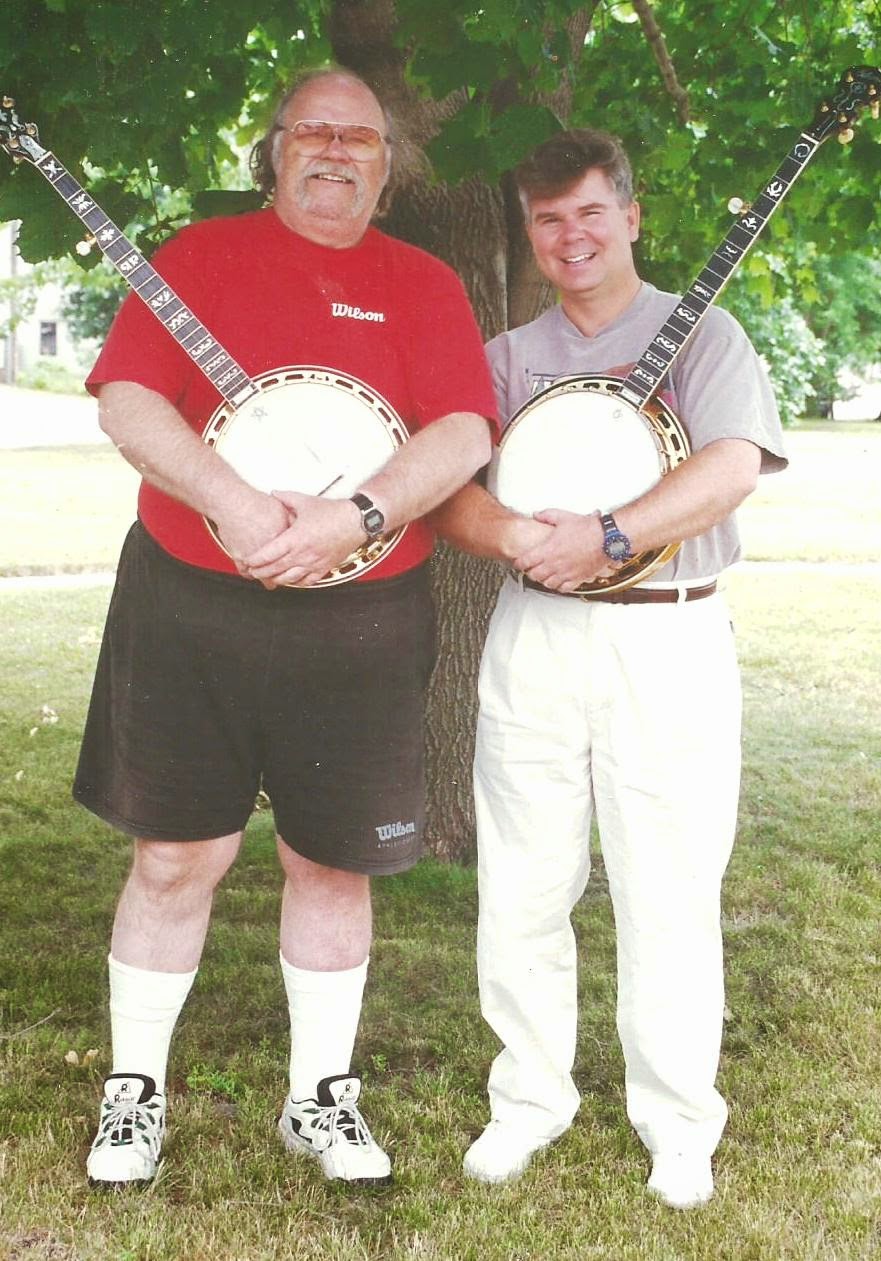
Third: Coach Sundeen and close friend and Winthrop roommate Dale Reed, with cherished banjos.

Fourth: The 1975 annual picture. Coach with tri-captains (me, Brian Gutknecht and Mark Trebelhorn)

Fifth: Charlie earning his 100th career win while at GFW.

Finally: Charley's wild side, one of many.