Wednesday, February 26, 2014

A return to the arts
I always wanted to be a singer-songwriter. It was my dream, maybe still is. When I was lucky enough to be chosen by the amazing Ronnie Brooks to participate  in what was then called the Institute for Renewing Community Leadership (IRCL), I surprised many of the 18 other participants by calling that my dream job.

Unfortunately, I'm not going to fulfill that dream...I don't think, but dreams should never die. Ronnie (right) wouldn't be happy with me. But life does bring on limitations. Talent's one of them!

Yet, music fills my soul and carries me places I would have never dreamed going. I have grown to have such an appreciation for music and the arts. I think it's in part because of those talent limitations, in part because I believe so strongly in a liberal arts education. Give every student a well-rounded taste of the arts and you'll have a better, deeper, kinder world.

Us IRCL alumni will always refer to it as such; it's actually now called the James P. Shannon Leadership Institute, with Ronnie Brooks as founder. Amazing people, amazing thoughts.

Over the past few weeks, I've been fortunate to watch and listen and enjoy several diverse regional artists: poet Matt Rasmussen, author Nicole Helget, artist Dana Sikkila and new Executive Director of the Arts Center of St. Peter, Ann Rosenquist Fee (below, right). This region is a far better place because of their presence here.


At the February 22 reading by Nicole and Matt at the Arts Center, some 100 people crammed into that fun space in downtown St. Peter.  The event also welcomed Ann as the new ED there, and her gifts to this region's art scene are already surfacing. What a talent. Ann left the corporate educational world of Minnesota State University-Mankato to be where she belongs -- in the arts and with her music. She and former Mankato Free Press writer Joe Tougas form the acoustical duo, The Frye.

In an interview prior to the Feb. 22 event, Ann explained her need to sing with The Frye nearly every weekend, despite an already hectic schedule: "It's something I need for my well-being. My fix. My high."

Music can do that to the soul. It should.

So can poetry. I'm horrible at it, lack the discipline I believe that's needed to frame those words just right. Matt, on the other hand, has nailed it. Here's what Amazon.com said about his five-star book of poems, Black Aperture, a Walt Whitman Award winner:

"In his moving debut collection, Matt Rasmussen faces the tragedy of his brother's suicide, refusing to focus on the expected pathos, blurring the edge between grief and humor. In "Outgoing", the speaker erases his brother's answering machine message to save his family from "the shame of dead you / answering calls..." 

"...Destructive and redemptive, Black Aperture opens to the complicated entanglements of mourning: damage and healing, sorrow and laughter, and torment balanced with moments of relief."


My take: Wow! His reading moved between dark humor and intense feelings. And a warm smile and deep heart that seems to suggest Matt's both moving on and holding tight. He acknowledged poetry gives him little financial reward, but that's his life work (along with teaching at Gustavus Adolphus College in St. Peter).


Nicole's writings are gaining more steam with her recent release, Stillwater. The Sleepy Eye native and current North Mankato resident weaves a historical story of trapper Beaver Jean in the late 1800s. I have not begun to read it, but if Nicole's inability to hold in her laughter at the Feb. 22 reading is any indication, I can't wait:

"I can't believe I wrote that!" she smiled, detailing a scene in which Beaver Jean attempts to bury his beloved horse, a creature he likely loved more than his three wives...


Dana Sikkila's energy might rival all of them. Dana works a 40-hour-a-week job as a digital press operator for Taylor Corporation in North Mankato, is an adjunct art professor at MSU, and serves as a volunteer executive director of the 410 Project, an eclectic art space in downtown Mankato. There she also serves as Artistic Director of Black Water Press, a community print-making concept for local artists.  And on March 20, Dana will have her own "installation art" exhibit at Twin Rivers Council for the Arts at 523 South Second Street in Mankato, just a block away from the 410 Project.

(Left: Dana Sikkila with Murphy.)


This collection of artists represents only a small portion of the growing pool of talent in the Minnesota River Valley region. Those who are part of that pool understand it already. Those of us still chasing our dreams are finding out, too, and loving it.


Ronnie Brooks' IRCL group of 1999 discussed Viktor Frankl's Man's Search for Meaning. As time continues to fly by and as I'm searching for hope and direction, I often turn to my IRCL journal:

  • Be more reflective
  • Take more risks
  • Take more spiritual risks
  • Take more emotional risks
  • Take more intellectual risks
  • Be more clear about purpose
  • Don't die alone/be connected
Simple stuff, really. Yet so very hard to hold tight. 


Sunday, January 26, 2014

These River Valley Women: Several who touched my soul in 2013

In another life, I used to spend some time in public speaking. It's part of the deal in the non-profit world. Or a brief, failed journey into politics. Or simply being asked when timetables are tight and others far more notable than yourself can't make an event. I understood my place in the pecking order.

As a long-time journalist and part-time political scientist, I would at times be asked a version of this question, "What one thing would best change the current state of politics and make for better government?"  My response was always this:

"Never again elect a white male to office."

Because those in attendance were usually more liberal than my rural neighbors, always more diverse, the comment would elicit some early laughs, then applause. You've got to know your crowd.

But I also meant it. Not that every female politician is better or less embarrassing. (See: Michelle Bachmann.) Yet, it would have to be better. Women bring a different perspective to politics. I'd say it's a broader perspective, more tolerable, more forgiving, more negotiable. (Some husbands might disagree, but that's another story.) And, frankly, us white males have pretty much screwed things up for a long time.

Where am I going with this? Well, it's been over a year since I brought words to this blog. Surprised me a bit when I saw the time lapse because it's not that I haven't been writing. Actually, I wrote more in 2013 than at any time since leaving an active journalism life some 20 years ago. It's just that I've shifted to other outlets. And it's brought me to some wonderful people, talents that have inspired me to do better, do more.

And they have deeply touched my soul.

For the past several months, I've been fortunate enough to write for River Valley Woman, a fresh, first-year magazine. Geographically, its delivery area runs from Redwood Falls to Henderson on the north, from St. James to Mankato on the south. It's allowed a return to those journalism roots. More importantly, it's given me opportunities to meet special young talents who are making a difference here and beyond.

Journalism never leaves your blood. You go into it for certain reasons; you leave it for basic economics. You return to it because of life circumstances and, likely, for the same reasons you originally entered the field. A love for telling a story.  It's a powerful thing when someone opens up their story to you and trusts you in telling it back. That deep-rooted trust is something I've never taken lightly. You've got to truly listen and watch. You've only got this brief period to capture one's heart and soul. And, man, what soul.

August: Nicole Helget. This gifted rural Minnesota writer has guts and talent and wit and eyes that melt one's fear away. When I was assigned my first cover story for River Valley Woman's August issue, I knew there was simply no way I could match Nicole's talents. It was a bit intimidating, to begin with. It remained that way through the final draft. And the fact that I had worked closely with her sisters and mother during a five-year stint in the kitchen at the Kaiserhoff in New Ulm made this one a bit more personal.


September: Sarah Kuglin. I love stories about rural Minnesotans who remain dedicated to this lifestyle. Sarah's social media, technology-based company -- Redwood Valley Technical Solutions -- is amazing. And when someone takes their business success and attempts to share it with others to help sustain our rural business landscape, you've got one special person. And I adore Sarah's last quote in the story: "Your world changes when you become a parent. When I think of the future, I hope my daughter someday can keep living in rural Minnesota."

October: Krista Morneau. Not all knew Krista was a "valley" girl. The Minnesota River Valley. She grew up in my hometown of Winthrop, attended GFW schools and also had a lake home in the Lake Crystal area. Married to former Minnesota Twins first baseman Justin Morneau, October was likely going to be my last opportunity to interview her for a cover story. Justin was likely going to be traded;
October is Major League Baseball playoff time. From the time I interviewed her but prior to publication, Justin was dealt to the Pittsburgh Pirates, a playoff team and an emotional run for the Morneaus. So, the story took a little turn, meaning River Valley Woman had an exclusive. Still, Krista's work with several charities in the Twin Cities region, particularly with Juvenile Arthritis, warranted a story on its own. They will be missed in the Twins family, and they will miss the Twins.

November: The Honorable Judge Krista Jass. She didn't like me using that term, which probably tells you everything you need to know about her. Grounded, appreciative of her opportunities, dedicated mother, and both tough and well-prepared as a young judge in Blue Earth County. The American judicial system isn't always fair and just; spending time with Krista immediately renews a bit of trust to one's being. Despite an immediate comfort in her office and with the interview, it was one of the more difficult interviews of these five young ladies, only because I'm thinking there was so much she could have shared with me, with our readers. She's smart, really personable and tremendously gifted. But judicial canons prevent her from talking on the major topics of the day. But she's ruled out a future run at politics, and that's too bad.

December: Lori Mathiowetz. This one surprised me the most. She's just 30, but an "old soul." That's what I called her almost immediately. and she smiled.  Lori said that's how her teachers and older, fellow graduate school classmates at St. Catherine University in St. Paul described her. That's maybe the end result of a master's degree in theology and certification in "spiritual direction." Lori combines her urban and rural teachings, merges it with the gifts of story-telling and listening, in encouraging "awareness and mindfulness" at Riverbend Spiritual Care in New Ulm. What a gift. What a talent. She and husband, Brett, along with daughters Lily, 6, and Evelyn, now eight months, just returned from Guatemala and work with the San Lucas Toliman Mission.

These were my five 2013 cover stories for River Valley Woman. Their stories continue to provide me hope for rural Minnesota. Their words, their trust in me, have --once more -- altered my life. Journalism is truly a noble art. At least it should be. It's played a critical role in shaping this country's existence, despite the merited criticism of today's talking heads on the cable networks.

Writing for a magazine, a first for me, is a little different. Working for River Valley Woman as the token male is really different, in a good way. Feature stories are fun, meeting wonderfully talented individuals and attempting to tell their stories. I laughed when a friend asked my wife, "When is Dana going to write some stories about men?"  See: Above.

Saturday, January 18, 2014


(Note: With this morning's deflation of the famed Metrodome's roof, I pulled out this remembrance of our family's first & last game all together at the stadium in the Twins' final season there in 2009. For many, the Dome highlights were football and the Vikings. But for us, baseball ruled. -- Dana Melius, January 18, 2014.)

October 21, 2009

Metrodome memories: It wasn’t pretty, but it served us well
By Dana Melius

Corralling six kids, as a rule, is a difficult task.  When they’ve spread throughout the country – throughout the world, at times – it gets even tougher.  So, to have all eight of us in tow for the Minnesota Twins’ final weekend of baseball -- the October 3, 2009 game -- at the often-maligned Hubert H. Humphrey Metrodome, well, as daughter Ambryn put it, was “not too shabby, folks.”

Our family had never quite warmed up to the Metrodome.  For starters, our first-born, Ben, didn’t arrive until August 1979, just months before dome construction began in that peculiar industrial area of Minneapolis, just off the I-35 freeway.  The power players who snared the Twins from Bloomington and old Metropolitan Stadium called it downtown, but it never quite seemed like it to me.  Cousin Gary “Gigs” Saxton and I lived at 1104 South Eighth Street, downstairs, at the time the Metrodome site was named, and we couldn’t quite see it.  Bad roads, bad access, little room, still blocks from the more “vibrant” Hennepin Avenue district.  Or maybe it was the smoke from the burning mattress on the front yard.  It wasn’t a pretty area.

But a mere eight years later, Ben would join me for that wonderfully unexpected World Series championship run by the Twins.  Section 141, Row 22, Seats 31 and 32.  We took in the opening game win versus Detroit in the American League Championship Series, nearly catching Dan Gladden’s home run; and we were waving our Homer Hankies in a Game 1 World Series victory over the St. Louis Cardinals.  My dad, Pud – quite the baseball lover, himself – was only half-joking about his omission from those games.  He died April 14 of this year, still longing for one more Twins miracle season.   I’m hoping he saw it. 

Pud always saw the special connect baseball held in the lives of Minnesotans, long before the Metrodome and Twins.  He played and managed town team baseball during the ‘40s and ‘50s, when it was king in rural Minnesota.  Communities planned their weekends around town team ball, with local crowds usually in the hundreds, sometimes in the thousands for big games.  When the Twins arrived in 1961 to Bloomington, it still felt a long ways from the big Twin Cities, so there was an immediate attachment for rural Minnesotans, longing for big-league baseball.

The 1982 move to the dome changed that for a spell.  While we could be assured of a game in 70-degree indoor weather, it was Minneapolis.  Traffic, parking woes, seedy business fronts.  It took some getting used to for those of us in Greater Minnesota.  But as in most sports, winning has a way of taking care of most woes.

There are other grand Metrodome memories.  GFW’s state championship football game in the fall of 1989 was very special, helping to unite the three communities early in the school’s history.  Watching the boys play high school baseball there was nice, and being on the field as a GFW baseball coach was a grand experience.  Even once brought Puddy to a GFW game there. And almost lost him when the wind gust entering the Dome nearly did him in and he slammed up against a cement wall, not wanting to go on. We had to wheel him in on a delivery cart as he moaned about the embarrassment and kept complaining, "God, do we have to do this!" 

But when I think of the Dome, I think of the Twins…and that ugly, yet unique baseball stadium.

Twins baseball remains something special in Minnesota.  While the Vikings actually rule the state of sports here – especially now, especially with Favre – Twins followers have an odd spirituality about the team.  I believe it goes back to that surprising 1987 World Series run, while the Vikes have floundered in their four Super Bowl tries.  But two of our children – Andy and Mikell – had not yet been born.  Andy arrived in 1989, after World Series #1; and our baby, Mikell, was born in 1992, after the classic World Series championship versus the Atlanta Braves.  They only remember Kirby Puckett’s heroics in Game Six and Jack Morris’ 10-inning masterpiece in video.

So the Melius family hasn’t had a lot of opportunities to get all six kids here at once.  Making it even tougher, daughter Ambryn’s been to India twice, and son Matt spent 18 months on the island of Diego Garcia, in the middle of the Indian Ocean.  With Ambryn coming home from her new residency in Seattle, and Matt finally back from San Diego after his five-year Navy stint, the time finally seemed right. With time running out, a last-minute organizational effort – and some pure luck in scheduling – brought the entire Melius clan together.  So, on October 3, for the first and last time, all eight of us gathered to take in a Twins game during the Metrodome’s final weekend.   Meeting at the Mall of America (and that’s an entirely different story), we took the light rail transit into the Dome.

We settled into Section 103 in centerfield, just happy to be a part of the festivities.  We were one of few fans who brought Homer Hankies from days gone by, waving them during Twins’ highlights.  And none was better than Michael Cuddyer’s game-winning home run, which extended Minnesota’s Central Division hopes of catching the Detroit Tigers…again. 

While we all later agreed that Game 163 might have been better, this one was just fine.  For the purpose of this trip wasn’t just baseball.  My wife, Kim, of 30 years, and all six of our children – Ben, Ambryn, Bill, Matt, Andy and Mikell – were together at the Dome.  And I made a special point of looking up at that ugly, discolored Teflon roof and thought of Dad.  Puddy loved the Twins. 

That’s what makes baseball so special, it’s for the generations.  And the Metrodome played host to it all.  So long, dear friend.

Tuesday, November 6, 2012

Election eve & night 2012: Looking ahead, it’s good to look back

As we await official 2012 election results, my mind has been wandering over the past two days.  I’m a self-proclaimed political junkie who drifts between extreme optimism and horrid cynicism.  No doubt, Election 2012 is going to bring mixed results, messages and on-going political turmoil and gridlock.  There is no true light at the end of this god-forsaken tunnel.

But it is our tunnel. It is our hole and for all of us to dig out.  Not one by one, not by leaving some behind, but collectively. Together.

My guess is we won’t even know the end result of this presidential election for at least 10 to 14 days, as Ohio’s provisional ballots are contested and counted.  It’s really the last thing this country needs, another presidential election in which the winner is disputed, in which Barack Obama or Mitt Romney face both a fractured Congress and nation.

In Minnesota, we’ve seen both sides of all this madness in the proposed amendments.  While Facebook friends may grow disgruntled by the recent onslaught of new cover and profile photos and public policy debate, this is good stuff.  Social media has lifted these critical issues out of the back rooms and into our homes.  And that should be applauded.

All I truly know is that no matter what transpires after today and tonight, these discussions should not end and will not.  And this state and its people will continue to address the issues of gay and lesbian rights, as well as designing fair and just ways to vote.

Many of you may seem overloaded and desiring a reprieve.  I’m saying it’s only just begun.

Remembering the ’98 Ventura win…and the issues
In November 1998, Jesse Ventura might not really have shocked the world by winning Minnesota’s gubernatorial election, but it was quite a stunner in Minnesota and beyond.  Time magazine captured this November surprise. Who would have predicted it?

I did. The problem was there was no one to hear me; nowhere was my grand prediction documented.  There was no Facebook. Ventura won with 37% of the Minnesota vote.  Republican Norm Coleman followed with 34%, while early ’98 favorite and DFL-endorsed Hubert H. “Skip” Humphrey slipped to just 28%.

At the time just after the September primaries which elevated both Coleman and Humphrey past party challengers, Ventura – officially the Reform Party candidate but really an independent – had garnered just more than 10% in a Minneapolis Star Tribune poll.  But by October 20, Ventura had jumped to 21%. And after a series of very effective debates against his stuffy, predictable and cautious challengers, Jesse “the Body” was gaining steam.

In the week before the election, I joined a quiet meeting in Gaylord at the Sibley County Courthouse basement, but one news flash stuck out: Sibley County’s U of M Extension agent reported that nearly all of the area homemakers she surveyed were planning to vote for Ventura.  In this rural and conservative county, there was spiked anger at politics-as-usual.  Ventura’s slogan and libertarian style fit: “Don’t vote for politics as usual.”

McLeod and Sibley County voters were among those to lead the Ventura revolution. Consider this odd list of counties which saw a majority (or near-majority) of voters swing Ventura’s way in ‘98:
1.        Isanti                     52.9%
2.        McLeod                52.8%
3.        Chisago                52.8%
4.        Wright                  51.4%
5.        Sherburne            51.2%
6.        Anoka                   50.7%
7.        Sibley                    49.7%
8.        Kanabec               49.6%

Ventura’s strange brand of ’98 politics included support for gay rights and gays in the military, for medicinal marijuana, for opening a debate on the legalization of prostitution, support for public schools but against teachers’ unions, and for an overall limited/libertarian style of government. And despite his U.S. Navy Seal tenure and patriotic wave, as governor he vetoed a bill to require recitation of the Pledge of Allegiance in schools.

It was Ventura’s style that captured disenfranchised voters’ attention in ’98.  It’s his past issues – particularly on gay rights – that have resurfaced again in 2012.  He and wife Terry were featured in a September TV commercial for Minnesotans United For All Families, pledging to “Vote NO” on the upcoming marriage amendment.

"I certainly hope that people don't amend our constitution to stop gay marriage because, number one, the constitution is there to protect people — not oppress them", Ventura said.  “Government should not be telling people who to fall in love with.”

And this is our new state representative?
Despite McLeod County’s 1998 vote for a very socially liberal Ventura, it’s bright red. It’s a yellow dog Republican district.  Consider some of these positions by Rep. Glenn Gruenhagen (R-Glencoe), who is poised to win today against the very bright and capable (but young) DFL challenger, Logan Campa.

At an April “Pro Marriage Amendment Forum” in Waconia, co-sponsored by “reformed” homosexual Kevin Petersen, Gruenhagen labeled all gays and lesbians as “unhealthy sexual perverts.”  A sitting Minnesota state representative speaking these words?  This one-term legislator’s long, rambling letters to the editor in Glencoe newspapers may be legendary in McLeod County, but most Sibley County residents are just getting to know him.  As a Sibley County resident, the redistricting moved our citizenry into one shared by much of McLeod County, one which left Gruenhagen as the sitting “incumbent.” 

My final glimpse of Gruenhagen’s strange demeanor and words came at an October debate in Glencoe, and from his odd opening to his final, bizarre words tying pornography to domestic abuse, his political views continue to range from embarrassing to unsettling.  He is oddly placed as a state rep, most interested and out-spoken on health care and climate change.  But he’ll likely be a winner again tonight.

Looking ahead
At times it seems as if we’ve moved so far beyond that odd, yet historic election of 1998.  But as a nation, we’ve become more polarized.  And within of Minnesota, the marriage and voter ID amendments have added to this discourse.  Add to that the influence of money in state and national politics has grown beyond distasteful; but there are few signs of slowing it all down.

Tired of it all? Well, get ready for a tumultuous four years.

Finally, the most important speech any of us will likely hear this election season is yet to come – the concession speech of either Obama or Romney.  Like Al Gore of 2000 and John McCain of 2008, it is that special, often once-in-a-lifetime chance for a prominent national voice to bring all of us together. 

Or to at least try.  And whether that speech comes in the early hours of November 7 or after yet another prolonged election challenge and counting of provisional ballots in Ohio, we’ve gotta keep trying.

Tuesday, October 9, 2012

Election 2012: The most important of my lifetime

Election 2012 is heating up on several fronts, from Minnesota’s “Marriage Amendment” to the Great Debates. At age 55, I’ve witnessed and analyzed far too many of these shows, but I’m willing to claim that this is the most important of my lifetime.

Four key ingredients are making this so:
  1. Minnesota’s “Marriage Amendment” is the civil rights issue of a generation.
  2. President Barack Obama vs. Republican challenger Mitt Romney.
  3. A second state constitutional amendment question: Voter ID.
  4. Glenn Gruenhagen (but he’s going to take up an entire second blog by himself) 
If I haven’t bored you yet, you likely qualify as a bona fide politico wonk (or maybe a family member).  But those of you who truly know and understand me know that progressive politics runs deep in my veins, and community journalism never leaves the soul.  Put the two together and you know one has to blog a little about this November 6 election and the meaning to all this madness.

Minnesota’s “Marriage Amendment”
A facebook friend of mine recently posted this on her page: “I am dead serious when I say, if you are voting YES for the marriage amendment, delete me as a friend. Now.”

I would never go that far, but I’m close. There is so much wrong with this hurtful and discriminatory amendment that one should be able to think outside the box or the Bible’s Old Testament ways to muster up a NO vote.  I can understand if one’s traditional religious views are so deeply rooted in one’s core value system that it becomes difficult to separate from one’s political position.  But this amendment proposal is also bad politics and public policy.

Never has there been such a generational split on a key public policy issue.  Younger voters will overwhelmingly cast NO votes on this “Marriage Amendment,” while votes will shift toward YES as demographics turn older. A generation from now, as GLBT rights become even more commonplace and widely accepted in our society, this issue will appear similar to the women’s suffrage movement which produced the 19th Amendment to the U.S. Constitution in 1920 allowing women to vote or the Civil Rights Movement of the ‘50s and ‘60s for African-Americans.

Love comes in many shapes and sizes. And good parenting doesn’t necessarily mean only a man and a woman.  To deny those who love each other the right to marriage or to even suggest that children will better flourish in a traditional husband-wife household simply seems wrong and discriminatory in today’s society.  Supporters on both sides of the aisle may twist figures to suit their cause; but common sense must prevail on this one.  Good, loving relationships make for good parents.  Good parenting is good parenting.

It’s the Bible and religion which makes this issue different. And that is a difficult argument to counter and argue against for many conservative Christians.  But not all are, and when a public policy issue like this enters the political arena, it also becomes an issue of freedom – both of individual rights and religious freedom. Or even the freedom to not be religious. And I simply find it the height of hypocrisy for a Republican party, which prides itself on advocating limited government, supporting amendments which suppress personal freedoms.

Finally, don’t clutter the Minnesota Constitution.  We should never impose a majority vote to constitutional frameworks. 

Obama vs. Romney
President Obama and GOP challenger Mitt Romney seem like polar opposites.  They’re not, and the reality remains that little will change no matter who wins the presidency, unless congressional gridlock loosens up. 

But despite Romney’s damaging “47%” comments, this race appears close.  It’s amazing to me.  And it speaks broadly of a U.S. electorate which has grown more intolerable toward others.  This era of “personal responsibility” sounds good and makes for easy sound bites, but the real world it ain’t.

America has always taken care of its neediest citizens.  And it should.  It seems easy to criticize this nation’s welfare system; yet, the majority of “welfare” programs are dedicated to our elderly, especially those in nursing homes.  It is easy to point fingers at illegal immigrants; but this finger-pointing too often profiles and labels legal immigrants, as well, and doesn’t point a firm enough finger at businesses who want and need cheap labor or an American citizenry that won’t work such jobs.

I, too, have been disappointed in Obama’s first term on several fronts.  But it’s hard to dispute he inherited a horrible mess from the George W. Bush administration: Two wars without proper dedicated funding and an historic economic downturn prompted by the housing crash and Wall Street greed. And the Obama administration has little to nothing to do with a world economy which has also slowed dramatically.

It seems a simple choice to me.  And that’s what makes me uneasy.  For a Romney presidency, especially on  taxation and foreign policy, scares me.

The Voter ID Amendment
This effort has been all about politics.  Rampant voter fraud is an urban myth brought on by the most recent close election calls, both going the Democrats’ ways (Mark Dayton over Tom Emmers for Minnesota governor and Al Franken over Norm Coleman for U.S. Senate).

Voter fraud is rare and inconsequential in determining electoral winners.  But limiting fair access to Minnesota’s polling places appears unconstitutional on the surface and just darn stupid.  It will make it more difficult for the elderly who no longer hold picture IDs and those of college age, who often hold multiple residences.  It could easily disenfranchise these voters, make it more difficult for them to register and, thus, marginalize their voting experience.  Both groups, not coincidentally, are more apt to vote Democratic.

And this change would cost Minnesota cities and counties a hunk of change to implement.

Again, a Republican party that promotes limited government wants to impose a government-certified picture ID? Nuts.  While many citizens see this as a simple issue (as in, “Everyone citizen should have a picture ID. What’s the big deal?”), it isn’t.  It’s making an issue out of a non-issue.  And very, very political.  There are many key issues this political season.  Voter ID shouldn’t have been one of them.

Monday, September 10, 2012

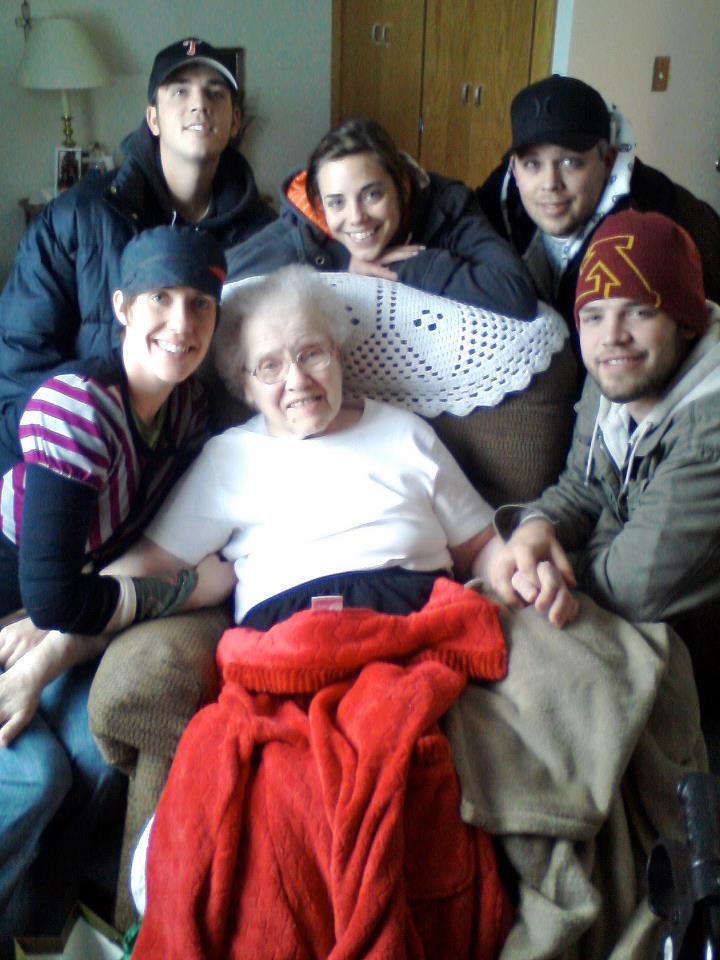
Mom, surrounded by five of our six children: Clockwise, from  bottom  left -- Ambryn, Bill, Mikell, Matt, Andy.  Ben was at work in Mankato.

Karen Alma Melius

On Saturday, August 25, 2012, we buried my mother, Karen Alma Melius.  Mom had died a week earlier, August 19, at the Winthrop Good Samaritan Center.  She was 86.

Most of those years were good ones for Mom.  But not the last weeks.  Certainly not the last days.  I was ready for Mom to go.  That’s no way to live, no way to die.  That’s what I would tell family, friends, co-workers.

But I don’t think Mom saw it that way.  She wanted to keep living. I could tell. Her smile each day told me.  She told me.  Mom wasn’t ready to die.  I asked her.

“No. I’ve got more people to talk to,” she told me during her last week.  And she smiled, again. 

Mom  didn’t talk much in her final weeks.  She was unable to get out of bed.  She didn’t eat much, if anything.  But she still liked ice cream.  She always did, whether it was a Buster Bar at the Dairy Queen, or a sundae cone out of the grocery store freezer.  Those were among her treats.  And they were always better if she had one with her kids or her grandkids or her great-grandkids.

That was Mom’s life, that and Lyle’s Café.  Her younger sister, Marge Saxton Lindstrand, owned this Winthrop landmark for almost 50 years.  Mom  worked there the entire time, baking thousands of pies, quietly accepting the fact that a 94-year-old Pie Lady, Mina Peterson, got the first and biggest headlines in the mid-‘80s. 

Mom  loved Mina and worked side-by-side with this legend for decades.  But Mom’s pies were better and more numerous.  I remember a postcard from  a New York traveler who made a regular passage through Minnesota because he had found the best sour cream  raisin pie he’d ever tasted. From  New York, through Winthrop, Minnesota, en route to California!

I remember generations of families from  the Marshall area who would make Lyle’s Café their midway stop on the way to the Twin Cities.  That Hwy. 19 traffic, to and from  the Cities, helped make the legend of the Pie Lady and Lyle’s Café grow.  This little, 75-seat café on the corner of Winthrop’s stoplight was a proud fixture of this community for decades.  And it was a simple place where generations of Winthrop people loved to work.

“We had one of the best working together relationships any two people could possibly have,” remembered Gloria Kuehn, a fellow Lyle’s pie baker. “She was also a very, very dear friend and I have many wonderful memories of the times we spent together.”

Gloria was one of the lucky ones who learned some of Mom’s pie-baking tricks of the trade.  Mom  had no recipes, much to the chagrin of her family.  She just baked the pies by memory.  She swore her only real secret was using home-rendered lard for her crusts.  But there was so much more to that.  I would watch amazed as she took hours slow-cooking her raisins for the sour cream  raisin pie, puffing them  up just so.  And the meticulous way she lathered up her meringues, then spun them  just right for a look no one else could make. 

It all seemed so simple.  But few people could match her talents.  Gloria was one of the lucky ones Mom  taught.  Chris Smith, a fellow co-owner of  Lyle’s during the late ‘80s and ‘90s with me, was another.  Maybe that’s why it was those two who finally brought my tears during Mom’s funeral.  These were the pie bakers.  And Mom  was truly the Pie Lady.

As Chris and Kelly Smith walked up to Peace Lutheran Church, I cried for the first time over Mom’s death.  We had spent little time together through the past years, as the Smiths left the restaurant business as Kelly went into high school administration.  But as they approached, it was easy to recall how special those times had been.  How much simpler and different the world was, even just 20-25 years earlier.

An even earlier generation of Winthropites can share their stories, as well, of a Lyle’s Café that was the gathering place of Winthrop High School students after game days and nights.  Lyle’s Café was a vintage piece of Americana, but it was Winthrop’s place.

But that sense of community is forever altered when one finally says goodbye to his parents.  My dad, Louis “Pud” Melius, died April 14, 2009, at the age of 93.  Their home for all of my 55 years was at 410 North Hennepin Street in Winthrop.  I was both lucky and cursed to have lived just a block and a half away for the past 30 years. 

That’s close enough to have once looked out our picture window during a heavy snowfall and seeing my mother towing our toboggan with two loads of our laundry back to her place.  She had snuck in our house while I was shoveling snow in back, then whisked away knowing I’d be upset with her.  I was, at the time, and raced outside to catch her. 

“Just bored and trying to help you out,” Mom  said then.  I slowly learned to let her help. It’s what she wanted to do, help her kids.  It’s now part of Mom  and Dad’s legacy.  Despite limited means, they helped out whenever they could.  They rarely gave advice from  their parental chairs, but they would listen and provide support as each knew best.

But most of all, Mom  and Dad remained proud of their family and proud of their community.  Mom  gave her all to Lyle’s Café and her family.  Dad’s employment days at the old Midland station were proud ones, but his “retirement” and work at the Winthrop golf course were his golden times.  And both loved plopping down lawn chairs along the third-base line to watch the local town team  baseball games.

My parents’ journey together was a simple one.  So was their message.  “Be kind to others, be fair, and love your family.”

So I am  and I do.


Tuesday, July 10, 2012

Restorative justice: It's lacking in today's system

by Dana Melius 
Beyond the raw emotions and hints of class warfare during the recent Amy Senser criminal vehicular trial, the simple words of basic restorative justice finally surfaced Monday following her 41-month sentencing in Hennepin County court.

Senser apologized.  And the parents of Anousone Phanthavong forgave her in the death of their son, the 38-year-old chef at Minneapolis True Tai restaurant.

“It also marked the first time she said she was sorry, something Phanthavong’s family said contributed to their closure as much as a prison sentence,” wrote Minneapolis Star Tribune reporter Abby Simons in its July 9 edition.

Closure.  Too often in today’s criminal justice system there is too little.  Instead, victims and the court system seek punitive sentencing, then realize a prison sentence alone brings little peace and closure.  Victims deserve and should demand more.  And in some cases – many cases – justice would be better served.

It’s called restorative justice, and after more than a decade of advancement in Minnesota, we are losing ground on this front.  In this emotionally charged world since 9/11, the cry for personal responsibility, the ugly expansion of political posturing and revenge, there is little time and money for restoring justice.  Instead, we put people away and place a huge burden on criminals and taxpayers alike.  Worse, we offer too little restorative justice for victims. 

And that – restoring justice for victims – should be the court’s and, more so, society’s primary purpose.

Restorative justice done right is a powerful and effective tool.  And for the criminal justice system to better serve both victims and offenders, it must more effectively restore justice not just enforce punitive sentences.  Importantly and uniquely, each incident and its slate of involved parties vary in emotions and needs.  But today’s court system and its glut of cases have neither the time nor money to efficiently handle both.

However, getting this right is so critical for the healing process and for a more compassionate society.  Those of us objectively watching the Amy Senser trial unfold understand that could have been any of us. In a moment, lives change. Be it inattentive driving or filling gas on a freeway ramp, tragedies unfold. And criminal vehicular homicide sentencing has been getting much tougher in recent years, with the wave of cell phone texting accidents, on-going DWI citations, and we’ll see it again in the recent St. Paul Harding high school tragedy, in which a 16-year-old was run down in a park by an unlicensed driver.

But does a 41-month sentence for Senser allow closure for the victim’s family?  Or does a tearful, sincere apology best open the door for forgiveness and final closure?

Only the family of the victim truly knows and understands that.  And the difficulty in restorative justice is both understanding that and measuring its effectiveness. 

For our family, it was an easy call.  In December of 1997, son Benjamin returned to his Gibbon-Fairfax-Winthrop High School roots to watch a T-Bird boys basketball game. Leaving a couple minutes early, he was jumped by at least two Glencoe-Silver Lake High School students and knocked unconscious in a dark, back gymnasium  parking lot.  Investigators believe a single blow to the head knocked him out, but another 50 or more kicks to his head and body forced a difficult and anxious ambulance run to the very community hospital of the offenders – Glencoe.

I was the second person to come across Ben in the parking lot, just after a fellow GFWer raced inside to report the attack.  I watched as his face swelled and his eyes rolled back in his head.  It was as frightening a period ever in raising our six children.  And my initial feelings were of extreme anger.  Ben was a random victim.  The parking lot was nearly pitch dark, with no proper lighting.  The ambulance response seemed slow.  And as my wife Kim and I drove to Glencoe, I hoped to spot the offenders, somehow, somewhere.

We later found out that a group of young McLeod County men drove to the basketball game in search of a young Winthrop man suspected of assaulting one of their friends earlier in the week.  When he wasn’t found, they decked the first person out of the gym – Ben.  Two other GFW students were assaulted on the south side of the gym but neither sustained serious injuries.  Ben’s were.

Twenty-one young men – five adults and 16 juveniles – were later faced with felony assault or intent to riot charges. 

Ben was hurting but open and honest from  the start regarding his feelings in the matter.  Mob mentality among high school boys could escalate over the simplest of incidents, he said.  And successful felony convictions in this case could greatly hamper these young men’s educational and job paths.  When approached by the Sibley County Attorney’s Office and Court Services department about a restorative justice, “circle-sentencing” approach, Ben and our family agreed.

Although it was a lengthy, somewhat disjointed first attempt at averting the traditional criminal justice system, it was powerful for the Melius family.  All 21 alleged offenders – with parents – attended the circle.  Ben was allowed to speak and offered his forgiveness and understanding.  Several of the young men charged – as well as their parents – gave tearful apologies.  And as Ben left early prior to an agreed upon “sentence” by both victims and offenders, he shook the hands of all 21 young men.

It offered proper and powerful closure to Ben and our family.  Not surprisingly, others in the community disagreed and felt the offenders got off easy. But we knew it might have saved some of the offenders from the dark clouds of a felony conviction.  And while it did not spare our family from an unexpected criticism from many in the Winthrop community who didn’t see the justice and wanted greater punishment, we believed it was restorative justice at work.

And today, we continue to believe in it.  One of those 21 offenders eventually became close friends with my daughter, Ambryn, as they were among Gustavus Adolphus College students who traveled to India in 2001.  And I sat on the steps of the Minnesota State Capitol over a year later with this wonderful young man, protesting American bombings in Afghanistan and the war in Iraq.

Restorative justice is not easy work.  And it doesn’t fit sentencing guidelines, which have taken over the criminal justice system.  It’s why Amy Senser received at least the minimum of 41 months in prison for her responsibility in the death of Thai chef   Anousone Phanthavong.  Ms. Senser finally backed away from her lawyers at Monday’s sentencing and gave what was described as a “sincere apology.” 

And in the end, it just might be this apology and acceptance of responsibility that brings restorative justice and closure to the Phanthavong family.